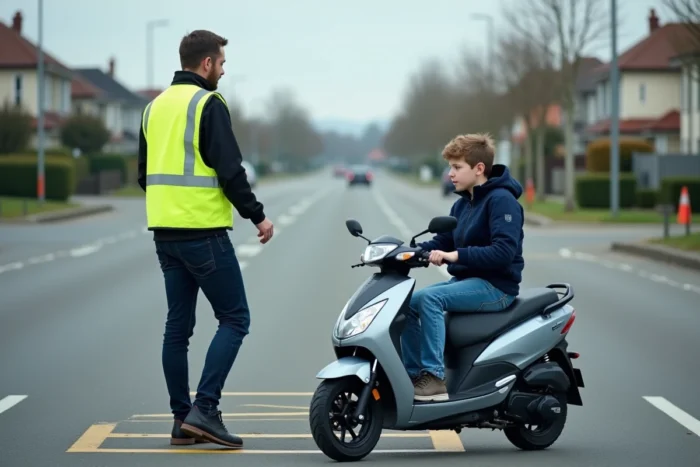
The BSR, officially designated as the category AM of the driving license, allows the driving of mopeds with a maximum engine capacity of 50 cm³ and light motorized quadricycles from the age of 14. The training leading to this category does not involve a traditional graded exam, but it may not be validated if the candidate does not meet the educational and regulatory requirements. Understanding these requirements helps avoid a failure that delays access to mobility by several weeks.
Mandatory equipment for BSR training: a reason for refusal even before riding
The primary cause of blockage during the BSR has nothing to do with driving. Without compliant equipment, the training cannot be validated, regardless of the candidate’s level. The instructor is legally obligated to deny access to the practical session if any item is missing.
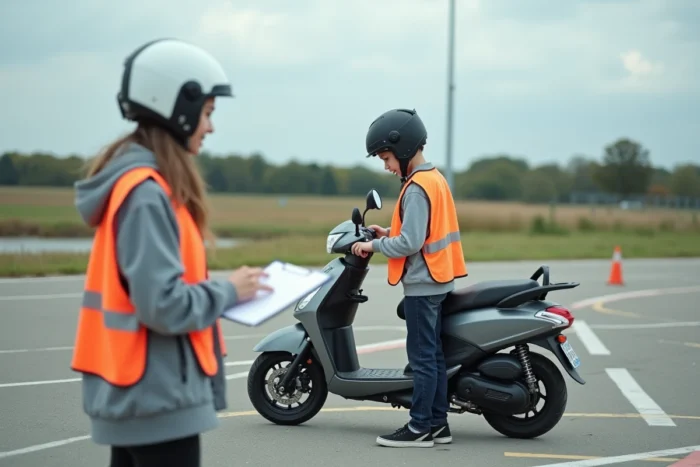
The required equipment includes an approved helmet, suitable gloves, a jacket, long pants, and high-top shoes. A candidate who shows up in low-top sneakers or without gloves will be sent away. The session is then postponed, which extends the total duration of the training and sometimes incurs additional costs depending on the driving school.
Before asking can you fail the BSR on Team Auto Passion, check that your equipment is complete. Refusal due to non-compliant attire remains the most common and easiest scenario to anticipate.

Educational progression of the BSR in 2025: sequences that pose problems
The AM training follows a structured program divided into distinct sequences. Each must be validated by the instructor to move on to the next. This progression is not just an administrative formality: it conditions the obtaining of the title.
Theoretical training and risk awareness
The theoretical part relies on the ASSR (School Certificate of Road Safety) obtained in middle school, or on the ASR for candidates who are not in school. Without this prerequisite, registration for practical training is impossible.
A risk awareness sequence complements this aspect. It addresses accident-prone situations specific to motorized two-wheelers: blind spots, emergency braking on wet roads, reaction distances. Candidates who treat this sequence as mere filler miss out on knowledge that is directly assessed during riding.
Off-road and on-road sequences
The practice is divided into two phases. The off-road section covers vehicle handling, starting, braking, and low-speed maneuvers. The most common errors concern the gaze and hand positioning on the handlebars, not the mechanical control of the scooter.
The on-road circulation tests the candidate’s ability to apply road safety rules in a shared environment. The instructor observes the management of intersections, respect for priorities, and anticipation of the behaviors of other users. A candidate who rides correctly but never checks their mirrors before changing direction does not validate this sequence.
Common errors that prevent BSR validation
The causes of failure in the BSR are not always related to a lack of driving skills. They often stem from an administrative preparation failure or an underestimation of the regulatory framework.
- Showing up without a valid ASSR or ASR. Some candidates discover on the day of registration that they have never taken the certificate in middle school, or that they have lost it. The request for a duplicate takes time.
- Ignoring the distinction by year of birth. People born before 1988 do not need the BSR to drive a moped or light quadricycle. Those born after 1988 must hold the category AM. A pre-selection error wastes time and money.
- Neglecting the minimum regulatory duration of the training. The program imposes a non-compressible number of hours. Trying to compress the training into half a day does not work: the instructor cannot validate an incomplete course.
- Underestimating the risk awareness sequence. This theoretical part is not optional. A candidate who is absent or passive during the risk awareness training jeopardizes overall validation.
Validity of the BSR and obligations after obtaining it
After obtaining it, subscribing to a specific insurance for the vehicle driven (scooter, light car, light quad) is mandatory. Riding without insurance exposes one to criminal penalties, regardless of the validity of the driving title. This point is often overlooked by young drivers who consider the BSR as an end in itself.
The AM category only allows access to vehicles with an engine capacity not exceeding 50 cm³ and a maximum speed of 45 km/h. Any modification of the vehicle to exceed these limits (de-restriction) voids the insurance coverage and constitutes an offense. A de-restricted scooter running at over 45 km/h falls outside the legal framework of the AM license, even if the driver holds the title.
The BSR remains the first driving title accessible from the age of 14, and its training deserves as much rigor as a B license. Arriving with complete equipment, the ASSR in hand, and a clear understanding of the program avoids the majority of blockage situations that candidates encounter each year.