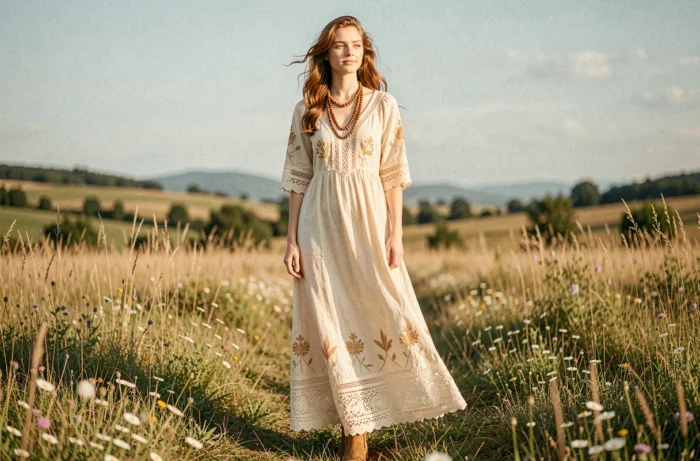
The bohemian style refers to a family of clothing codes built around natural materials, fluid silhouettes, and folk-inspired prints. Its roots delve into the counterculture of the 60s and 70s, but the bohemian fashion as it circulates on runways and in the streets has significantly evolved since the floral dresses and leather sandals associated with the hippie movement.
Natural materials and fluid cuts: the technical grammar of boho
Before composing a look, one must understand what distinguishes a truly bohemian piece from a simply casual one. The choice of material takes precedence over the cut. Linen, cotton, washed silk, crochet, cotton lace, suede: these textiles share a common trait, they move with the body instead of constraining it.
The cut follows the same logic. Silhouettes are loose or semi-fitted, rarely tight. A bohemian dress often falls below the knee, with a waist defined by a tie or elastic rather than a structured cut. Blouses favor pagoda or balloon sleeves, and pants adopt wide or flared legs.
Recent collections, particularly those led by the creative direction of Chemena Kamali at Chloé, have, however, altered this balance. The boho version for 2025-2026 incorporates cleaner lines, closer to minimalism, while retaining the characteristic materials and textures. Thus, on the Bohème Magazine fashion site, there are analyses of this fusion between bohemian fluidity and contemporary rigor, which well reflects the direction taken by ready-to-wear for the general public.
Boho colors and patterns: building a coherent palette
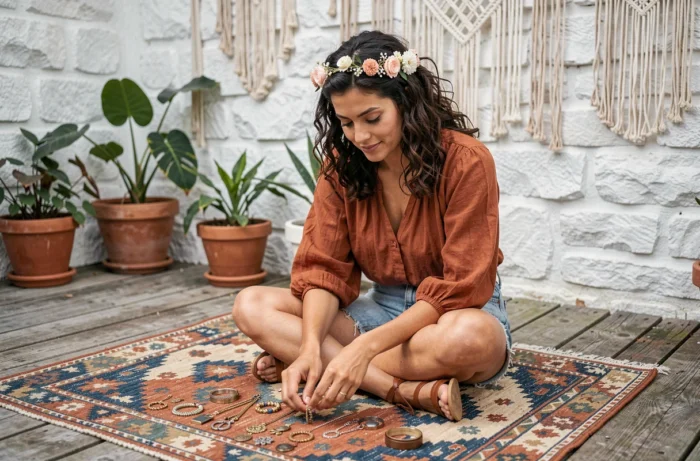
The bohemian palette is based on earthy tones and warm shades: ochre, terracotta, khaki, cream, rust. These natural colors serve as a neutral base on which patterns can be layered.
Floral, ethnic, and paisley patterns form the dominant trio. Their common point: they evoke craftsmanship, travel, a form of textile storytelling. Geometric prints inspired by Berber designs or folk embroidery from Eastern Europe also work very well.
To avoid the “costume” effect, a simple rule works: limit prints to one piece per outfit and anchor it with solid basics. A long paisley-patterned skirt gains clarity with a white linen top and natural leather sandals. Conversely, a solid wide linen pant can support an embroidered blouse without overwhelming the ensemble.
Boho silhouettes adapted to body shapes: dress, skirt, and pants
The bohemian style offers a wider range of silhouettes than what the cliché of the long floral dress suggests. Three categories of pieces structure a functional boho wardrobe:
- The long or midi dress, fluid, with an empire or gathered waist, which suits both A and H silhouettes because it creates volume without clinging the fabric to the body.
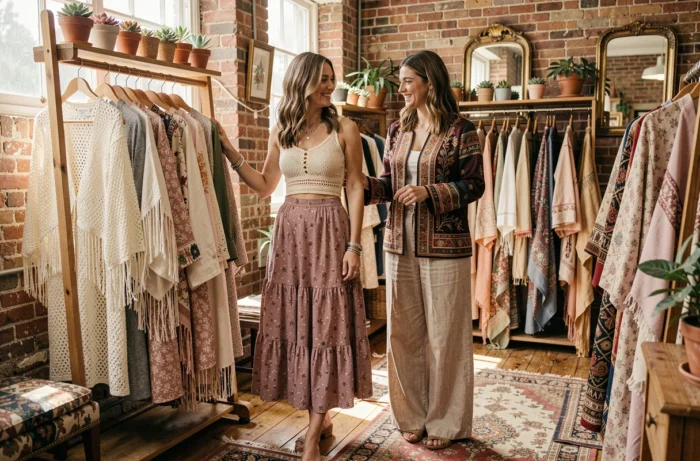
- The maxi skirt paired with a fitted top (crochet bralette, fine knit top, tucked blouse), which allows for playing with proportions and defining the waist.
- The wide or bell-bottom pants in linen or cotton, worn with a short blouse or sleeveless vest, which provides a credible alternative to the dress for more active days.
The secret to a successful boho look lies in the balance between upper volume and lower volume. If the bottom is loose, the top benefits from being closer to the body, and vice versa. This principle avoids the shapeless silhouette that has long hindered the image of bohemian style.
Leather accessories and artisanal jewelry: the accents that make the difference
Accessories play a structuring role in a bohemian look, more so than in other clothing registers. They serve to anchor the outfit in a specific universe and to prevent it from slipping into “too conservative” or “too hippie”.
Leather remains the flagship material. A soft leather bag, strappy sandals, a braided belt: these pieces add texture and contrast with the fluidity of the fabrics. The crossbody leather bag advantageously replaces the classic handbag and enhances the casual look without sacrificing practicality.
In terms of jewelry, boho favors pieces that appear artisanal: rings with natural stones, stacked bracelets, dangling earrings in aged metal. The recent trend for pearl and stone necklaces, noted in several trend analyses for 2025, fits into this logic. Stacking is allowed, as long as it stays within the same color family (gold or silver, not both).
The case of the hat and scarf
The wide-brimmed hat (felt in winter, straw in summer) is a strong marker of bohemian style. The scarf tied as a headband or around the neck offers a more discreet alternative. Both accessories add a “hairstyle” dimension to the look, making it immediately identifiable.
Recent variants of the bohemian style: moto boho and urban boho
Boho is no longer limited to a single aesthetic. Documented micro-trends for autumn 2025 and the year 2026 show that the style is fragmenting into distinct sub-currents.
- The moto boho combines bohemian pieces (fringes, fluid fabrics) with codes from the biker wardrobe: black leather, structured boots, darker palette. The result is a less sunny boho, suitable for colder seasons.
- The modern boho or urban boho refines traditional codes: fewer layers, more architectured cuts, a muted palette close to Scandinavian minimalism. Linen dresses fall straight, and accessories become scarce.
- The Western boho injects cowboy references (cowboy boots, oversized belt buckles, fringed suede) into a classic bohemian base.
These variants share a common foundation of natural materials and fluidity, but they allow for adapting bohemian style to very different contexts, from the office to a festival to a terrace dinner.
A sustainable boho wardrobe is built around five to seven key pieces in natural materials, complemented by leather accessories and artisanal jewelry. The rest is a matter of proportions, palette, and the variant that best suits your daily life.