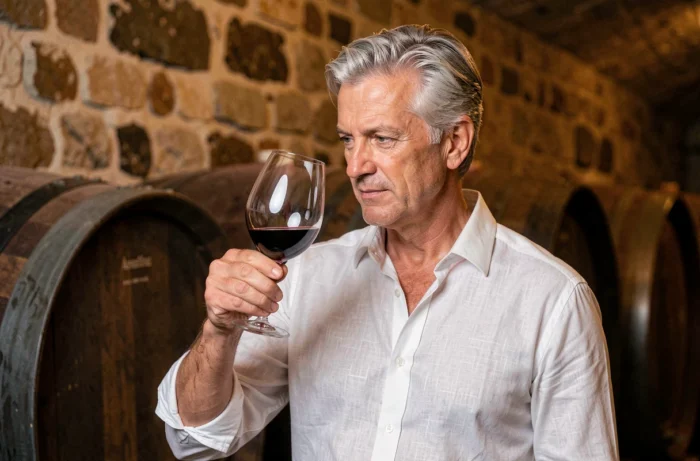
Bordeaux remains the only major French vineyard where almost all wines are blends. Understanding the logic of blending means understanding why two bottles labeled “Bordeaux” can have almost nothing in common. Here, we offer a technical reading of the appellations and grape varieties, focused on practical choices in stores or at the wine merchant.
VIFA System and New Grape Varieties Authorized in AOC Bordeaux
Since 2018, the INAO has established a regulatory framework called varieties of interest for adaptation (VIFA). This system allows Bordeaux appellations to test non-traditional grape varieties, selected for their resistance to climatic constraints, without immediately rewriting the AOC specifications.
In Bordeaux, two grape varieties are in the spotlight: touriga nacional, which tolerates summer heat better, and alvarinho, which adds extra acidity to whites. The first supervised trials began in 2021.
The constraints are strict. These varieties can only cover 5 to 10% of the experimental plots, and their proportion in the final blend is capped at 10% for a minimum period of ten years. In other words, you won’t see touriga nacional mentioned on a back label tomorrow, but its minimal presence is already altering the aromatic profile of certain experimental cuvées.
At the same time, ancient grape varieties like castets, once removed from the specifications, are being reintroduced for the same adaptation reasons. This movement signals a change in doctrine: the Bordeaux appellation is no longer a fixed repertoire; it evolves under climatic pressure. Anyone consulting a guide to Bordeaux appellations and grape varieties today must incorporate this forward-looking dimension.
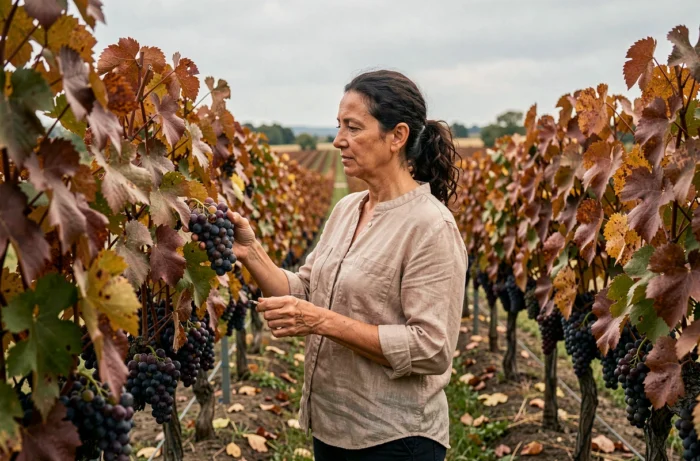
Bordeaux Blending: Reading the Dominant Grape to Anticipate Style
All Bordeaux wines are blends, but the relative proportion of grape varieties dictates the wine’s profile far more than the name of the regional appellation. We recommend thinking in terms of dominant grape variety rather than left bank or right bank, a shortcut that is too schematic.
Dominant Cabernet Sauvignon
Cabernet Sauvignon provides a tight tannic structure and high aging potential. It is the predominant grape in the blends of Médoc and Pessac-Léognan. The typical aromas revolve around blackcurrant, cedar, and graphite after a few years in the bottle.
A blend with more than 60% Cabernet Sauvignon is rarely intended for immediate consumption. Without three to five years in the cellar, the tannins remain austere. This is a point of caution for the hurried buyer.
Dominant Merlot
Merlot produces rounder wines, accessible when young, with notes of plum and black cherry. It dominates the blends of Saint-Émilion, Pomerol, and most right bank appellations. Its softness makes it the most planted grape variety in the Bordeaux vineyard.
A common pitfall: equating Merlot with simple wine. The best Pomerols, predominantly Merlot on deep clay, rank among the most expensive and complex wines in the world.
Cabernet Franc in Blend or in the Spotlight
Cabernet Franc often plays a complementary role, but it can represent the majority of the blend in certain Saint-Émilion estates. It brings floral notes (violet), a menthol freshness, and finer tannins than Cabernet Sauvignon. Identifying the proportion of Cabernet Franc on a technical sheet helps to identify elegant and digestible wines.
Regional, Communal, and First Growth Appellations: The Hierarchy that Sets Prices
Bordeaux has about sixty appellations, but the hierarchical structure can be summarized in three levels that directly determine pricing positioning.
- Regional Appellations (Bordeaux, Bordeaux Supérieur): broad specifications, higher permitted yields. These are entry-level wines, often predominantly Merlot, designed for quick consumption.
- Communal Appellations (Margaux, Saint-Julien, Pomerol, Saint-Émilion): restricted geographical area, stricter yield constraints, identifiable terroir profiles. The price reflects the notoriety of the communal name as much as the intrinsic quality.
- Classifications and Growth Mentions (1855 classified growth, bourgeois growth, grand cru classé of Saint-Émilion): these overlapping hierarchies add a layer of interpretation. A bourgeois growth from Médoc does not adhere to the same criteria as a grand cru classé from Saint-Émilion, and the two systems are not comparable.
The mention “Grand Vin de Bordeaux” on the label has no regulatory value. It does not guarantee a quality level or a classification. Only the AOC mentions and official classifications bind the producer.
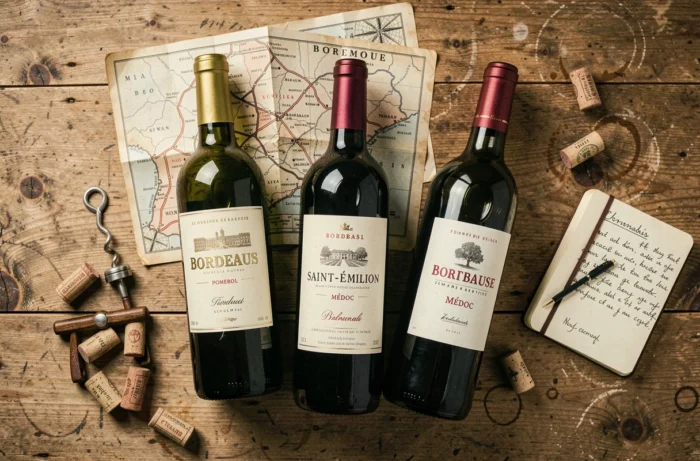
Dry and Sweet Bordeaux Whites: The White Grape Varieties to Know
Whites represent a minority of Bordeaux production, but their diversity deserves attention. Two grape varieties structure the offer.
Sauvignon brings freshness, liveliness, and citrus aromas. Sémillon, richer and rounder, forms the backbone of the great sweet wines of Sauternes and Barsac, where it develops aromas of honey, candied apricot, and saffron under the influence of noble rot (botrytis).
In dry white, the Sauvignon-Sémillon blends of Pessac-Léognan achieve remarkable complexity, with an aging potential that many consumers underestimate. A good producer’s Pessac-Léognan white ages as well as a first-growth white Burgundy.
Muscadelle, the third authorized white grape variety, plays a supporting role to add a floral touch. It rarely exceeds a few percent in the final blend.
The choice of a Bordeaux wine benefits from being approached as a decoding exercise: dominant grape variety, level of appellation, vintage. Bordeaux labels provide this information, but rarely in an explicit manner. Knowing how to read them transforms a rough purchase into an informed decision.