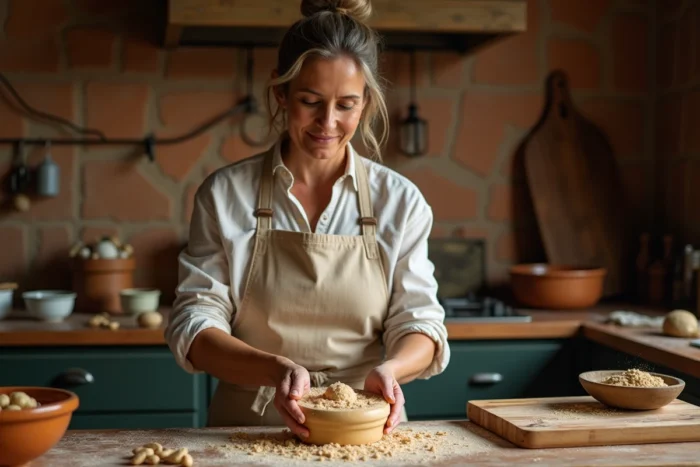
Brazilian paçoca relies on a handful of ingredients, but the differences in results between two homemade preparations can be surprising. Crumbly or compact texture, bold peanut flavor or muted by sugar, cylinder stability or crumbling at first contact: each manufacturing variable alters the final product. Understanding these variables allows you to recreate a candy at home similar to those served during the festas juninas in Brazil.
Peanuts for paçoca: homemade or industrially roasted, the impact on flavor
The choice of peanut determines the entire aroma. Classic French-speaking recipes almost always mention roasted peanuts bought in bags, often salted. In Brazilian markets, the trend goes in the opposite direction: natural peanuts, with no added salt, sourced locally, roasted on-site or at home.
The difference is noticeable right from the mixing stage. An industrial salted peanut releases less natural oil because the factory roasting process uses high temperatures that dry out the seed. In contrast, a pan-roasted peanut, cooked over medium heat for about ten minutes, retains more fat and develops rounder roasting aromas.
Consulting the paçoca recipe on Gourmand Sans Gluten provides a good overview of the proportions and the basic method, which can then be adapted according to the type of peanut used.
| Criteria | Industrial peanut (salted bag) | Homemade natural roasted peanut |
|---|---|---|
| Salt content | Added salt (variable depending on the brand) | No added salt |
| Oil release during mixing | Low (drier seed) | Medium to high |
| Aromatic intensity | Flat, sometimes rancid if the bag is old | Bold roasting aromas |
| Control of final sugar | Reduced (salt interferes with sweet perception) | Total |
| Stability of the paçoca cylinder | More crumbly | Better cohesion due to oil |
This table summarizes the main difference: homemade roasted peanuts provide a better natural binder, which changes the texture without adding external fat.
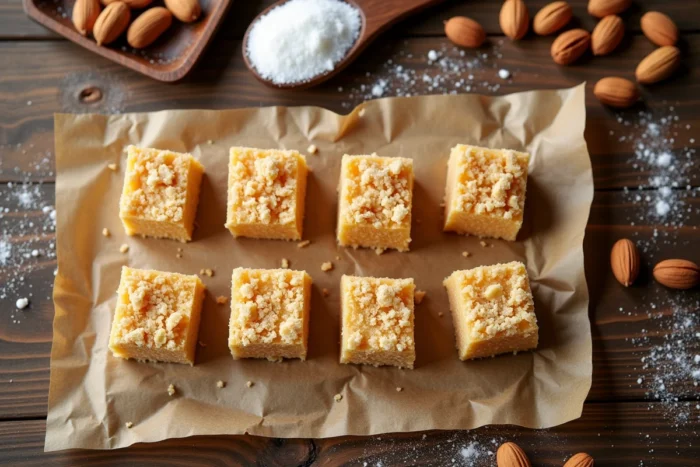
Sugar-peanut ratio and cassava flour: proportions that change the texture
Traditional paçoca combines three ingredients: roasted peanuts, sugar, and cassava flour (farinha de mandioca). Variations in the proportions of these three components explain why two homemade paçocas never look alike.
The role of cassava flour
Cassava flour absorbs the oil released by the peanuts and acts as a dry binder. Too little, and the mixture remains oily, impossible to mold. Too much, and the paçoca becomes sandy, loses its peanut flavor, and crumbles.
A useful guideline: cassava flour should not exceed one quarter of the total weight of the dry mixture. Beyond that, the candy loses its taste identity. The artisanal Brazilian versions found at festas juninas often use less flour than the recipes published online, precisely to preserve the intensity of the peanut flavor.
Sugar: white, brown, or rapadura
White sugar gives a neutral result, allowing the peanut aroma to shine through. Brown sugar adds a caramel note. Rapadura, unrefined cane sugar widely used in Northeast Brazil, produces a darker paçoca with molasses flavors.
- White sugar: homogeneous texture, peanut-centered flavor, quick dissolution during mixing
- Brown sugar: slight additional moisture, caramel aroma, more golden color
- Rapadura: pronounced cane flavor, more rustic and grainy texture, typical of the Brazilian Northeast
The choice of sugar also influences preservation. Rapadura, being more moist, makes the paçoca a bit stickier after a few days. White sugar offers the best longevity.
Mixing and molding technique: mistakes that ruin paçoca
Mixing too long turns the peanut into a greasy paste similar to peanut butter. The goal is to mix in short bursts to achieve a coarse powder with small pieces remaining. It is this irregular grain size that gives homemade Brazilian paçoca its characteristic texture, both melting and slightly crunchy.
After mixing, the mixture must be pressed firmly into a mold. A cylindrical cookie cutter works, but a simple empty toilet paper roll lined with plastic wrap works perfectly. The pressure applied must be firm: a poorly compacted cylinder will crumble upon unmolding.

Three common mistakes recur in failed attempts:
- Mixing continuously for more than thirty seconds, which produces a paste instead of a powder
- Using peanuts that are still warm after roasting, which melts the sugar prematurely and creates lumps
- Not pressing hard enough during molding, for fear of breaking the improvised mold
- Adding water or condensed milk to “bind” the mixture, which distorts the traditional recipe and prevents the sandy texture
Paçoca beyond candy: uses in Brazilian cuisine and the diaspora
In Brazil, paçoca is not limited to the cylinder that one bites into as is. Crumbled, it serves as a topping on ice creams, a layer in glasses with condensed milk and cream, or a base for chocolate-coated truffles. This culinary diversion is common during the festas juninas in June and July, where each stall offers its variant.
In the Brazilian diaspora in Europe, homemade paçoca plays a cultural bridging role during festivals or gatherings organized by Brazilian associations and houses. The artisanal versions prepared on-site, with local peanuts, replace imported industrial products. This context encourages adapting the recipe to available ingredients: cassava flour replaced by cornstarch or coconut flour, rapadura substituted with muscovado sugar.
These substitutions alter the texture and aroma but produce interesting results. Coconut flour, for example, adds a tropical fragrance absent from the original recipe while playing the same absorbing role as cassava flour.
Homemade Brazilian paçoca remains a candy whose success depends less on complex know-how than on good starting products and controlled mixing. Choosing natural peanuts, roasting them yourself, carefully measuring the flour, and pressing the mixture firmly: these four steps are enough to achieve a result true to what is found at the stalls of Brazilian markets.