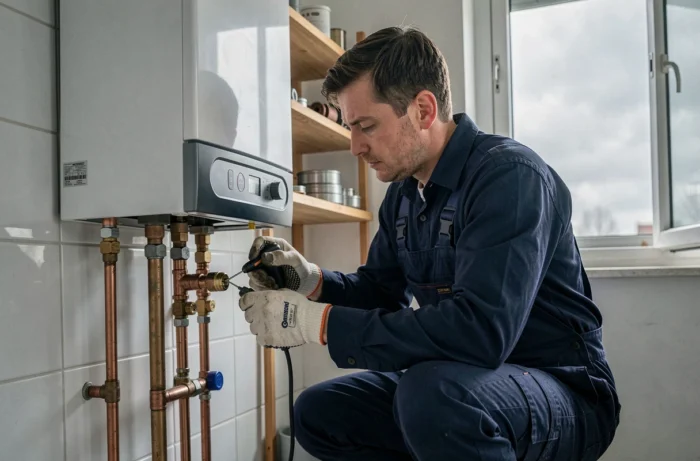
A poorly maintained heating system in Brussels does not just consume more. It exposes the owner or tenant to regulatory non-compliance, the consequences of which affect home insurance and the validity of the EPC certificate. Here we address the technical points that general public guides overlook.
EPC Control and Legal Frequency of Boilers in Brussels
The periodic EPC control is not just a comfort maintenance check. In the Brussels-Capital Region, the frequency of control varies depending on the fuel used. A gas boiler does not follow the same schedule as an oil boiler, and confusing the two can lead to a report during an energy audit.
This control assesses combustion efficiency, CO emissions, and the general condition of the burner. The certified technician issues a certificate that must be kept and presented in case of a claim. Without this document, an insurer may invoke a lack of maintenance to reduce or deny compensation.
We regularly observe installations whose certificates have expired for several months, sometimes because the tenant is unaware that this responsibility falls on them. Because in Brussels, routine maintenance and periodic control are generally the tenant’s responsibility, while the replacement or heavy repair of the boiler remains the owner’s responsibility, provided that the maintenance has been properly carried out. This distribution should be clearly stated in the lease to avoid any disputes.
Anyone looking to maintain their heating system in Brussels according to regulations should therefore start by checking the date of their last EPC certificate and the type of declared fuel.
Return Temperature and Heating Curve: Underutilized Settings
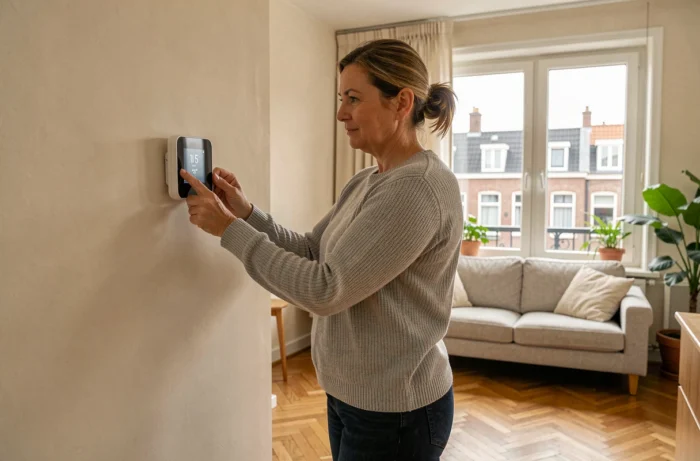
Most guides emphasize the room thermostat and thermostatic valves. These elements matter, but the parameter that has the most impact on the longevity and efficiency of a condensing boiler is the return water temperature to the boiler.
A condensing boiler only truly condenses if the return temperature drops below a certain threshold, generally around 55 °C for natural gas. Above this, it operates like a conventional boiler and loses most of its advantage. We recommend checking this point with a contact thermometer on the return line, not just through the boiler’s display, which may show a discrepancy.
Heating Curve and Outdoor Sensor
The heating curve connects the outdoor temperature to the water supply temperature. A poorly calibrated curve overheats the building in mild weather and underheats it in extreme cold. The appropriate setting depends on the building’s insulation, the type of emitters (steel radiators, cast iron, underfloor heating), and the thermal inertia of the home.
If an outdoor sensor is installed, it automatically controls the modulation. In its absence, the boiler operates at a fixed temperature, negating any climate regulation. Installing an outdoor sensor on a boiler that does not have one represents a moderate investment with a direct impact on the gas bill.
Hydraulic Circuit and Radiator Sludge
A sludged circuit can significantly reduce the power delivered by the radiators, even when the boiler is functioning correctly. Sludge, composed of metal oxides and corrosion residues, settles in the lower parts of the heat exchangers and in the bends of the network.
Several signs indicate advanced sludge accumulation:
- Hot radiators at the top and cold at the bottom, even after a proper air purge
- Abnormal circulation noise in the piping or in the circulator (pump)
- High temperature difference between supply and return, greater than what the sizing predicts
- Progressive overconsumption without changes in habits or degradation of insulation
Chemical or hydrodynamic desludging must be performed by a heating technician equipped with a flushing pump. After the operation, adding a corrosion inhibitor to the circuit limits the reformation of sludge. A magnetic sludge pot installed on the return line protects the boiler and circulator over the long term.
Heat Pump Maintenance: A Still Vague Framework in Brussels
Heat pumps are multiplying in the Brussels stock, but their mandatory maintenance framework is less codified than that of gas or oil boilers. The absence of combustion does not exempt from regular technical monitoring.
The critical points of an air-water heat pump include:
- Checking the refrigerant charge and detecting leaks, subject to F-Gas regulations
- Cleaning the outdoor heat exchanger, as clogging from leaves, dust, or pollen reduces the COP
- Checking the circulator on the hydraulic side and the circuit pressure, identical to that of a boiler system
We recommend an annual visit by a certified refrigeration technician, distinct from the conventional heating technician. The cost is comparable to that of a gas boiler maintenance, but the required skills are not the same.
Safety and CO Detection
For combustion systems (gas, oil), a carbon monoxide detector remains a safety complement not to be overlooked. The annual maintenance checks the tightness of the exhaust duct, but a malfunction can occur between visits. A certified CO detector is inexpensive and can prevent serious poisoning.
A well-maintained heating system in Brussels relies on three concrete pillars: adherence to the EPC schedule with retention of certificates, fine-tuning of the heating curve and return temperature, and monitoring of the hydraulic circuit’s condition. Neglecting any of these aspects is enough to degrade overall efficiency and engage the liability of the tenant or owner according to the terms of the lease.