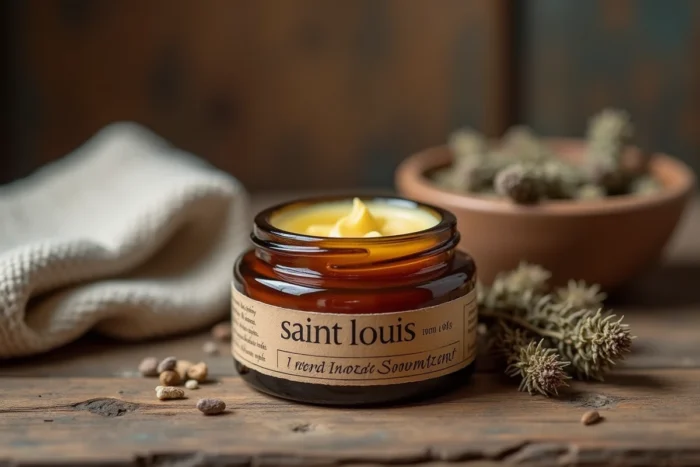
A persistent redness on a baby’s bottom, a skin irritation that resists standard creams: it’s often in these situations that Saint Louis ointment comes up in conversations among parents or caregivers. This preparation, made directly in pharmacies, evokes a particular attachment among those who have tried it. But what exactly is it, and why does this formula transcend generations?
Magistral preparation and not an industrial drug: what this changes
Have you ever searched for Saint Louis ointment on an official medication reference site, without results? That’s normal. Saint Louis ointment is not a medication with a marketing authorization (MA). It is a magistral or officinal preparation, made by the pharmacist according to a traditional formula.
In practical terms, this means it is not produced in a factory by a pharmaceutical laboratory. Each compounding pharmacy makes it from a known recipe, with dosages that may vary slightly from one establishment to another. This status explains its absence from the public database of medications from the ANSM.
For the patient, the difference is significant: it is impossible to order this ointment from a large online parapharmacy. You must go through a pharmacy that has a compounding facility, such as the Kerangal pharmacy in Rennes, which is frequently mentioned for this type of formula. Several users regularly share their reviews of Saint Louis ointment, which helps to get an idea before asking their pharmacist for it.
Zinc oxide, lanolin, petroleum jelly: how these components protect the skin
Rather than talking about a “miracle formula,” it is more useful to understand why these ingredients work together. Let’s take a simple example: when a baby’s skin remains in prolonged contact with a wet diaper, it becomes irritated. The skin barrier, normally waterproof, weakens.
Saint Louis ointment addresses this issue through a logic of three-layer mechanical protection:
- Zinc oxide acts as an astringent and drying agent. It absorbs excess moisture and helps calm superficial redness.
- Petroleum jelly forms an occlusive film on the skin. It prevents external irritants (urine, feces) from worsening the lesion.
- Lanolin, derived from sheep wool, limits water loss from the skin. It maintains a sufficient level of hydration beneath the protective barrier.
This combination is not revolutionary in pharmaceutical technology. It is based on principles shared by other pediatric preparations containing zinc oxide. The value of Saint Louis ointment lies more in the specific balance between these three components, adjusted by decades of use in pharmacies.
Mechanical protection, not targeted pharmacological action
One point deserves clarification. Saint Louis ointment does not treat a disease in the strict sense. It protects, soothes, and promotes healing by restoring a favorable environment for the skin. This is a nuance that forums sometimes overlook when attributing virtues to it for psoriasis or severe eczema.
For these chronic conditions, the ointment can temporarily relieve discomfort, but it does not replace a treatment prescribed by a dermatologist. Expecting it to be a universal remedy is to ask it to do what it is not designed to do.
Diaper rash in infants: why Saint Louis ointment remains popular
It is on diaper rash that Saint Louis ointment has built its reputation. User feedback, particularly on health professional forums and parent groups, converges on one point: it often works where standard diaper creams fail.
Why? Diaper creams sold in supermarkets generally contain a lower concentration of zinc oxide, sometimes combined with fragrances or preservatives that can themselves irritate already weakened skin. Saint Louis ointment, prepared in pharmacies, contains simple ingredients, without unnecessary additives.
Current recommendations and limits to know
Recent pediatric recommendations emphasize one point: limit the number of ingredients applied to infants’ skin. In this logic, preparations based on zinc oxide with a short formula (few components) are favored.
Saint Louis ointment fits into this approach. It contains no fragrance, no coloring, and no complex preservatives. However, the lanolin it contains can, in rare cases, cause a reaction in hypersensitive skin. If irritation persists or worsens after application, medical advice is necessary.
Obtaining Saint Louis ointment: the pharmacy journey
Not all pharmacies have a compounding facility. This is the main practical obstacle. To obtain this ointment, there are two options:
- Ask your usual pharmacist if they make officinal preparations. If they do not, they can often order it from a partner compounding pharmacy.
- Contact a pharmacy specialized in magistral preparations directly, which may be able to ship it under certain conditions.
- A prescription is not always necessary for an officinal preparation, but some pharmacies may require it. Check in advance.
The price varies from one pharmacy to another since there is no regulated price for magistral preparations. Coverage by health insurance depends on the prescription and the context in which the preparation is made.
Saint Louis ointment is not a marketing product. It is a simple formula designed to protect fragile skin with ingredients whose effectiveness is based on decades of clinical observation in pharmacies. For resistant diaper rashes, it remains an option to discuss with your pharmacist, keeping in mind that no ointment replaces a medical diagnosis when irritation persists.