
Descending to a Parisian metro station with a double stroller or a wheelchair often means finding that the elevator shown on the map does not exist or is out of order. The Paris metro network has included accessibility since the commissioning of line 14 in 1998, but the vast majority of older stations remain without facilities adapted for people with reduced mobility.
Structural gap in the network: why the Paris metro remains so inaccessible
The 2005 disability law does not set any deadline for making the metro accessible. Work on older lines is considered too complex due to the depth of the stations, the narrowness of the corridors, and the lack of technical shafts to install elevators. Efforts have therefore been primarily directed towards the surface network (buses, trams) and new lines.
The recent case of the Austerlitz station illustrates this logic well. A modification created a new internal connection with a staircase and two escalators to streamline passenger flows. The RATP explicitly stated that this modification does not improve accessibility for people with reduced mobility, as no elevator has been installed. Investment is made in overall flow, not in adaptation for wheelchairs or strollers.
When looking for metro accessibility solutions line by line, it quickly becomes clear that the equipped stations can be counted on one hand for most historical lines.
Accessible stations for wheelchairs and strollers: where are they really
Line 14 is the only line fully accessible to wheelchair users, with elevators, platform doors, and level platforms at each station. Recent extensions of other lines apply these same design criteria, but they only concern the new stations added at the end of the line.
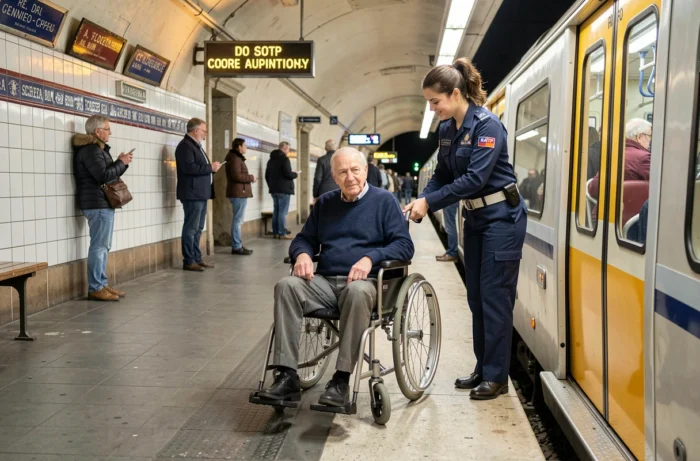
For the rest of the network, only a handful of stations out of more than 300 have a functional elevator connecting the street to the platform. APF France handicap has highlighted this glaring imbalance. Stations equipped with escalators make life easier with a lightweight stroller, but they remain unusable for a standard wheelchair.
Some concrete guidelines for preparing a trip:
- Line 14 (Saint-Denis Pleyel – Orly Airport) is the most reliable choice for a fully accessible journey, from the platform to the exit
- Stations built or renovated during recent extensions (e.g., ends of lines 4, 11, 12) generally have elevators, but transferring to an older line often negates this advantage
- RER stations shared with the SNCF (Châtelet-Les Halles, Gare du Nord, Gare de Lyon) more often offer elevators, even if breakdowns are frequent
Bypassing the old metro: RER, buses, and single ticket as accessible alternatives
Since 2026, Île-de-France operates with a single “Metro-Train-RER” ticket at a flat rate of 2.55 euros at full price (1.30 euros at reduced fare), valid on metro, RER, and suburban trains, including destinations like Versailles or Disneyland Paris. Only airport stations require a specific ticket costing 14 euros.
This fare simplification changes the game for families with strollers and people with reduced mobility. You can now choose an RER or train route without extra cost, even if the journey is longer in distance. RER and Transilien stations, designed more recently or renovated, more often offer elevators and ramps than century-old metro stations.
The bus network remains the most direct alternative. All RATP buses are accessible to wheelchairs thanks to deployable ramps and low floors. For a stroller, it is also the simplest means: you board through the central door, place yourself in the designated space, without stairs or narrow corridors.
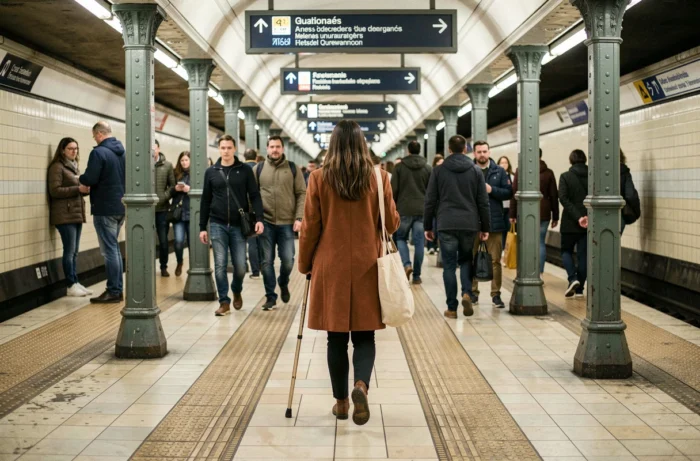
For those whose disabilities make conventional public transport impossible, the PAM (Pour Aider à la Mobilité) service in Île-de-France offers on-demand transport. A new contract was awarded in October 2026, with changes in the organization of the service.
Preparing an accessible journey in the Paris metro: tools and reflexes
The RATP app and route planners like Île-de-France Mobilités allow you to filter journeys by checking the “accessibility” option. The result often suggests a mixed bus-RER route rather than a 100% metro journey. This is an indicator in itself: the algorithm itself avoids the old metro for people with reduced mobility.
Some operational reflexes before leaving:
- Check the status of elevators in real-time on the RATP app or the Île-de-France Mobilités website, as breakdowns are frequent and rarely reported in advance
- Prefer off-peak hours (mid-morning, early afternoon) to avoid crowds in narrow corridors and crowded trains where unfolding a stroller becomes impossible
- Anticipate transfers: an “accessible” station at entry may involve a change at a station that is not accessible at all
Feedback varies on this point, but folding the stroller and carrying the child in a baby carrier often remains the most pragmatic solution for older lines. This is obviously not an option for wheelchair users, which brings us back to the initial observation.
The old cardboard t+ tickets remain usable until autumn 2026 and exchangeable until January 14, 2027. The transition to all-digital can complicate life for users with reduced mobility who are not comfortable with apps or contactless cards. Planning to get a rechargeable Navigo Easy pass at the ticket counter remains the simplest solution to avoid tactile terminals that are sometimes placed too high or without voice guidance.
The Paris metro was not designed for wheelchairs or strollers, and no plan for overall accessibility is scheduled for historical lines. Line 14, buses, and the RER remain the three real pillars of accessible travel in Paris.