A cat that doesn’t return at the usual time often triggers a disorganized search. The majority of lost cats are found alive within a radius of 500 meters around the point of escape, with a median around 50 meters. Focusing efforts on this restricted perimeter, with a rigorous method, yields better results than searching broadly without a plan.
Search perimeter and behavior of the lost cat
A cat in a stressful situation adopts a behavior of immobilization. Injured or disoriented, it hides in the nearest shelter and waits, sometimes for several days, for the perceived threat to disappear. This instinctive reaction explains why most lost cats remain at a very short distance from home.
We recommend starting with a methodical grid search within a radius of 50 meters: under cars, dense hedges, garden sheds, crawl spaces, open garages. A frightened cat will not respond to its name during the day. Night searches, between 10 PM and 2 AM, are significantly more effective because ambient noise decreases and the feline dares to signal its presence more.
You can explore how to find a lost cat with La Maison des Animaux to complement this approach with appropriate administrative steps.
The key point to remember: never widen the perimeter before thoroughly searching every nearby nook, including high places. Cats climb onto roofs, get stuck in gutters, or remain perched in a tree unable to come down.

GPS tracker for cats and ICAD identification: two distinct safety nets
Identification by microchip (I-CAD national file) and GPS tracker address two different scenarios. The microchip does not locate the animal in real-time: it only links a found cat to its owner when scanned by a veterinarian or a shelter. The cellular GPS tracker, on the other hand, transmits a usable position immediately.
Data collected from several hundred loss incidents show that animals equipped with a cellular GPS collar are recovered significantly faster than those relying solely on the microchip. The average recovery time drops from several days to a few hours in documented cases.
Technical limitations of consumer trackers
Bluetooth models like AirTag have uneven coverage in rural or suburban areas. Their range depends on the network of compatible devices nearby. In the countryside, a cellular tracker with an integrated SIM card remains the only reliable option.
- Cellular GPS tracker: real-time location, monthly subscription, limited battery life (a few days to a week depending on the model)
- Bluetooth tracker (AirTag, Tile): no recurring fees, but dependent on the network of surrounding users, not well-suited for sparsely populated areas
- I-CAD microchip: mandatory in France, free after installation, effective only if the animal is captured and scanned by a professional
We observe that the combination of I-CAD microchip plus cellular GPS tracker offers the best coverage. The microchip remains the last resort if the GPS collar is lost or discharged.
Night recall techniques to bring back a missing cat
The so-called used litter method is based on a simple olfactory principle: the cat recognizes the smell of its own pheromones from a distance. Placing the uncleaned litter box in front of the door, accompanied by a piece of clothing worn by the owner, creates a sensory anchor that the feline can detect even when disoriented.
Taking out wet food at a fixed time every evening reinforces this setup. The cat associates a schedule with a food source and eventually approaches it. We recommend staying nearby, motionless and silent, for at least thirty minutes after placing the bowl.
Why not give up after the first week
A significant portion of cats is recovered between the seventh and thirtieth day after disappearance. Late searches, conducted consistently, regularly yield results, even for cats considered unfindable after a few days.
Maintaining olfactory devices in place, continuing night rounds, and checking daily for announcements on the I-CAD file and local reporting groups increases the chances of recovery well beyond the first week.
Effective reporting: I-CAD file and local networks
The report of loss on the I-CAD national identification file should be made within hours following the disappearance. This report allows any veterinarian, shelter, or pound that scans your cat to access your contact details immediately. Without this report, even a microchipped cat can remain stuck in the pound.
- Report the loss on the I-CAD website with the cat’s identification number
- Contact veterinarians, shelters, and pounds within a few kilometers
- Post an announcement with a recent photo in neighborhood groups (local social networks, neighborhood apps)
- Check daily for found animal announcements on I-CAD and local platforms
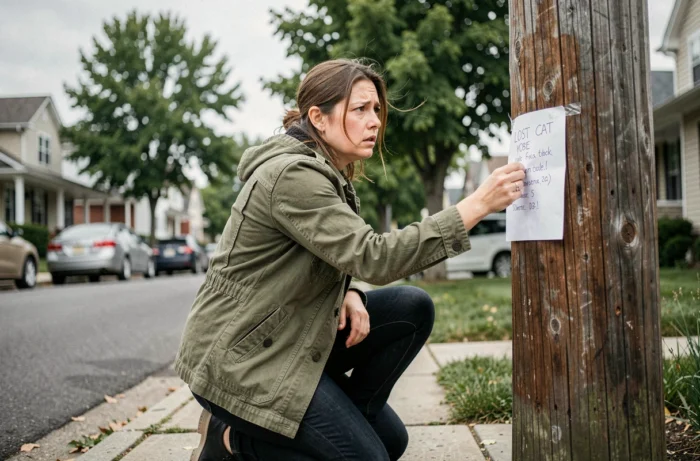
Paper flyers remain useful as a supplement, provided they include a clear photo, the location and date of disappearance, and a reachable phone number. Place the flyers at eye level, at intersections, and near local businesses.
A cat identified and reported lost on I-CAD has a much higher chance of being returned than an unreported cat, even if the latter wears a collar with a tag. A collar can detach or be lost, whereas the microchip remains readable as long as the animal is scanned.
The consistency of efforts matters more than their initial intensity. A cat hiding just a few meters from your home can take weeks to emerge from its hiding place. Maintaining the night recall routine, checking reports, and keeping the olfactory device active are the three actions that, combined, produce the best-documented recovery rates.