
On an island where professional journeys rarely exceed fifty kilometers per day but include constant elevation changes between the coast and cirques, the choice of fleet motorization is not reasoned the same way as in mainland France. In Réunion, one in two new cars registered in 2026 is hybrid, according to Entrepreneur.re. For fleet managers, this shift is not a trend: it responds to very concrete operational, fiscal, and logistical constraints.
Elevation and regenerative braking: the Réunion terrain favors full hybrid
A salesperson descending from the Plaine des Cafres to Saint-Pierre recovers energy at every bend thanks to regenerative braking. On a flat urban route, this recovery remains modest. On Réunion’s roads, the gain becomes tangible because deceleration phases are long and frequent.
The full hybrid (HEV) operates without a charging station. You plug nothing in, you plan nothing. For a fleet of technicians or delivery drivers who make rounds between Saint-Denis, Le Port, and Saint-Benoît, this logistical autonomy is significant. There’s no need to install charging stations in the company parking lot or manage nighttime charging slots.
Feedback varies on actual consumption depending on driving style, but the island’s terrain mechanically increases electric assistance compared to metropolitan highway use. Here, hybrid technology is leveraged more than in Bordeaux or Lyon.

Incentive annual tax and fleet greening in Réunion
Since March 1, 2025, companies with 100 or more light vehicles are subject to an incentive annual tax (TAI) that replaces the previous greening quotas of the LOM law. The principle: the percentage of low-emission vehicles missing from the fleet is calculated, and a fee per missing vehicle is applied.
Objectives are progressing quickly: 15% low-emission vehicles by 2025, 18% in 2026, 25% in 2027, up to 48% by 2030. The fee per missing vehicle doubles between 2025 and 2026, turning greening into a real budget item.
For Réunion fleets, plug-in hybrids or full hybrids do not always count as “low-emission vehicles” under the TAI (only electric vehicles and certain PHEVs below an emissions threshold are eligible). We explore in detail hybrids for automotive fleets in Réunion on Exploractu to understand which models are included in the calculation. Checking the exact classification of each vehicle before signing a leasing contract avoids unpleasant fiscal surprises.
Plug-in hybrid in Réunion: a declining tax advantage
PHEVs have long attracted fleet managers due to their partial exemption from the weight penalty and their very low CO2 emissions on paper. The reality on the ground is less flattering.
- Since 2025, plug-in hybrids no longer benefit from the exemption from the weight penalty. The residual reduction is limited to 200 kg, capped at 15% of the vehicle’s weight.
- The additional purchase cost of a PHEV compared to a full hybrid remains significant, and profitability depends on disciplined daily charging. Without this, actual consumption often exceeds that of a conventional HEV.
- Starting in 2027, the scheduled removal of the specific tax deductibility for PHEVs will further reduce the gap with full hybrid motorizations.
On the ground, it is observed that many fleet PHEVs operate in thermal mode most of the time because employees do not consistently charge them. The full hybrid requires less user discipline and delivers fuel savings without usage conditions.
What additional cost to accept for a PHEV in Réunion
The calculation depends on annual mileage and the actual ability to charge each night. For a fleet whose vehicles park in areas without charging stations (construction sites, multi-site rounds), the full hybrid remains the most predictable choice in total cost of ownership.
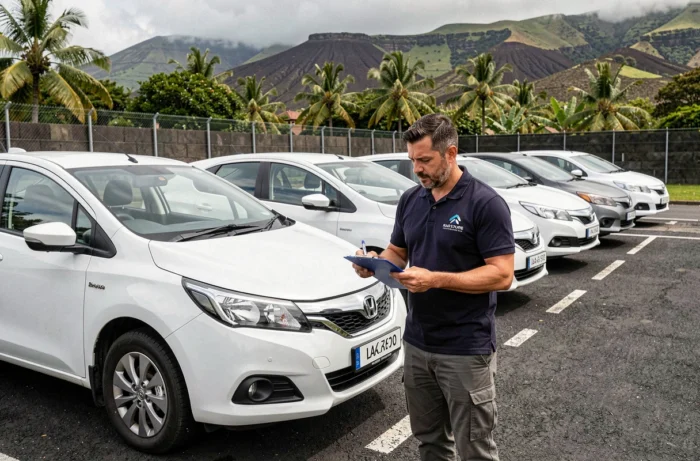
Total cost of ownership of a hybrid fleet in an island context
The price of fuel in Réunion is structurally higher than in mainland France, which amplifies every saved consumption point. A full hybrid that consumes significantly less than an equivalent diesel generates savings per vehicle that, multiplied across a fleet of several dozen units, visibly alters the annual budget.
The maintenance of a full hybrid costs less than a diesel over the holding period. Brake pads wear out less quickly thanks to regenerative braking, and the absence of a timing belt on certain models eliminates a costly maintenance item. On an island where delivery times for spare parts can be extended, reducing the frequency of mechanical interventions also limits vehicle downtime.
The resale market also plays a role. Hybrids retain a better residual value than diesels in Réunion, driven by strong local demand. For a manager who renews their vehicles every three to four years, this better trade-in value offsets part of the initial additional cost.
Gradual transition: integrating hybrids without disrupting the fleet
Replacing an entire fleet at once makes no economic sense. Start with vehicles whose leasing contracts are expiring and whose usage profile (mixed urban-periurban trips, moderate mileage) corresponds to the best hybrid performance.
- Identify vehicles that travel less than 30,000 km per year, where the hybrid consumption gain is proportionally the strongest.
- Prioritize high-visibility positions (executive vehicles, field sales) to enhance the responsible brand image.
- Monitor actual consumption month by month via onboard telematics to compare hybrid and thermal costs on the same routes.
This gradual replacement approach also allows for adjusting the motorization mix based on regulatory evolution. If the TAI tightens its thresholds faster than expected, we accelerate. If the charging station network develops sufficiently, we shift certain positions to pure electric.
The Réunion automotive market confirms the trend: the share of hybrids in new registrations exceeded half of the market in 2026, while diesel is declining. For a professional fleet, aligning with this dynamic also ensures smooth access to parts, local dealership expertise, and adapted financing conditions.