
Maximillion Cooper is not just a name associated with a spectacular rally. Born on June 7, 1972, in the United Kingdom, this former race car driver turned entrepreneur has built a brand ecosystem around a single idea: transforming car culture into a global lifestyle product. His fortune, estimated at $60 million according to the Anglo-Saxon press, is based on economic mechanisms far more diversified than a simple annual event.
Gumball 3000: Business Model Beyond the Car Rally
The Gumball 3000 rally, launched in 1999, remains the foundation of the Cooper empire. The initial concept combined car racing, pop culture, and VIP access for wealthy participants willing to pay high entry fees. What sets Gumball apart from a classic rally is its positioning as a media and event platform.
Each edition connects iconic cities (London, Paris, Tokyo depending on the year), generating international press coverage. Revenue does not come solely from registrations. Gumball 3000 operates as a brand in its own right, with licensing partnerships, textile collaborations (notably with Puma and Adidas), and its own clothing line, Gumball 3000 Apparel.
In recent years, we have observed a transformation of the model: Cooper positions Gumball 3000 within business and lifestyle events aimed at entrepreneurs and investors. The rally becomes a pretext; the brand sells a comprehensive experience and a network. This diversification largely explains why Maximillion Cooper’s net worth far exceeds what a traditional rally organizer could accumulate.

Charitable Foundation and Laureus Strategy: An Underestimated Reputation Lever
Most portraits of Cooper focus on the jet-set side of the character. The structured philanthropic dimension takes a back seat, which is a mistake. Cooper has developed a foundation under the Gumball 3000 banner focused on education and sports for underprivileged youth in the UK.
This charitable aspect is not anecdotal. It fits into a logic of institutional credibility that opens doors with corporate partners and international sports organizations. The link with the Laureus universe (the world of sports and philanthropy) reinforces Cooper’s positioning as a networking figure in European entrepreneurial circles.
- The foundation funds educational programs for youth from disadvantaged backgrounds, primarily in England
- Charitable partnerships serve as a showcase to attract institutional sponsors to Gumball 3000
- Cooper uses these networks to anchor his brand within investor circles, not just in the celebrity sphere
This dual strategy (profitable events + structured philanthropy) is a common pattern among Anglo-Saxon lifestyle entrepreneurs, but Cooper has applied it with a rare coherence in the automotive sector.
Maximillion Cooper and Eve: A Couple as a Media Brand
Cooper married American rapper Eve in 2014. Their relationship, often reduced to a celebrity curiosity, actually constitutes a cross-visibility asset. Eve brings an American and musical audience, while Cooper brings the European automotive and entrepreneurial universe.
The couple shares a child and lives between London and the United States. This dual geographical presence is not a detail: it allows Gumball 3000 to maintain media presence on both sides of the Atlantic without a massive advertising budget.
Cooper had four children from a previous relationship before his marriage to Eve. The management of this blended family, well-documented in the celebrity press, regularly fuels media coverage of the couple and, by extension, the Gumball brand.
Cooper’s Journey: From Race Car Driver to Multisector Creative
Before Gumball 3000, Cooper trained in fashion and design. This background explains the aesthetic coherence of the brand, from the logo to textile collaborations. Cooper is not a traditional automotive entrepreneur but a creative who chose automotive as a medium.
His past as a driver gives him legitimacy in the motorsport world, but it is his vision of the brand as a cultural product that made the difference. He attempted to acquire a Formula 1 team before pivoting to the celebrity rally concept. This pivot, far from being a failure, has proven to be much more profitable than a loss-making F1 team.
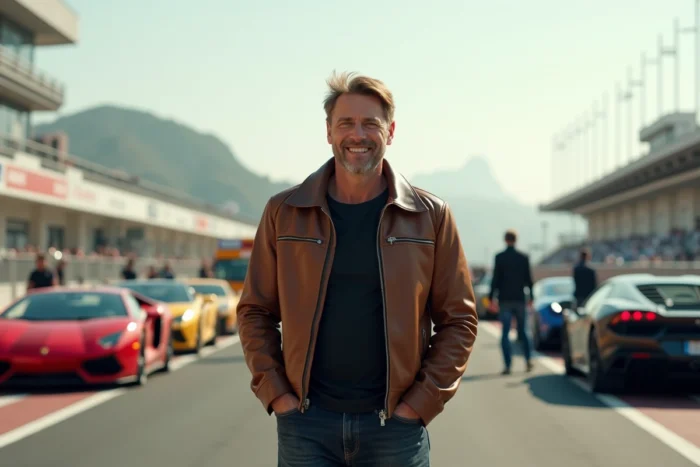
Cooper collects items related to Steve McQueen, including a 1940s BSA B40 motorcycle converted for motocross. This taste for vintage car culture fuels the Gumball 3000 brand identity: a mix of nostalgia, luxury, and controlled rebellion.
- Initial training in fashion and design, not automotive engineering
- Failed attempt to purchase an F1 team before creating Gumball 3000
- Deliberate positioning at the intersection of motorsport, fashion, and events
Maximillion Cooper’s Fortune: What Estimates Don’t Say
Public estimates place Cooper’s fortune around $60 million. This figure, cited by most celebrity sources, never breaks down the assets. However, the real value rests on several distinct pillars.
The Gumball 3000 brand itself (rights, licensing, events) likely represents the most significant share. Recurring revenues from textile collaborations and brand partnerships constitute a steady stream. Real estate assets and Cooper’s personal car collection add a layer of heritage that is difficult to evaluate from the outside.
The Cooper model relies on converting a passion for cars into a global lifestyle brand. This approach, closer to a Red Bull than a traditional race organizer, explains the gap between public perception (a guy who organizes rallies) and financial reality (a multisector group with diversified revenues). The next logical step for Gumball 3000 involves digital content and expansion into new investor markets, a territory that Cooper is already actively exploring.