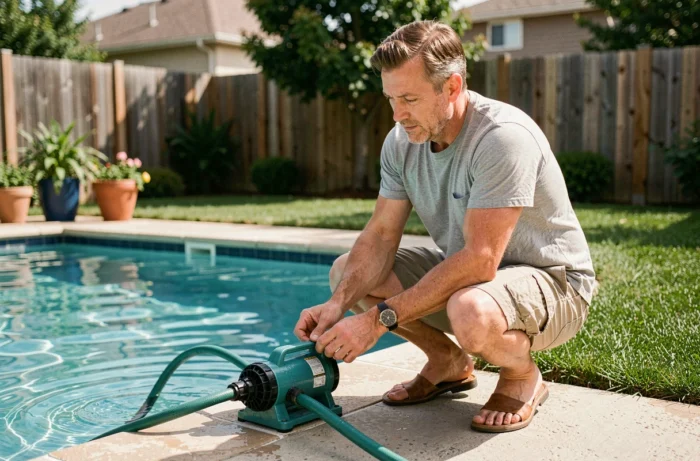
A swimming pool that turns green or becomes cloudy is not always the result of poor maintenance by the owner. External factors, sometimes trivial, can destabilize a pool in just a few days. High temperatures, an undersized filtration system, unstable chlorine levels: the causes are numerous, and the resulting neighborhood conflicts are too. This issue goes beyond a simple summer anecdote. Behind the question of the water turning lies legal, technical, and relational stakes that most articles on neighborhood issues do not address.
Abnormal neighborhood disturbance related to the pool: what the law allows you to prove
The majority of online content focuses on the noise from the pump. The problem is broader. A poorly maintained pool can generate visual, olfactory, and health nuisances that constitute an abnormal neighborhood disturbance in legal terms.
French law does not set specific thresholds for private pools. The assessment relies on four combined criteria: the intensity of the nuisance, its duration, its repetition, and the local context. Stagnant water that attracts mosquitoes or emits odors can therefore be classified as a disturbance, even without exceeding a specific noise level.
Contrary to popular belief, the nuisance does not have to occur at night to be recognized. Several recent legal sources remind us that the disturbance can be characterized both day and night as long as it affects the tranquility of the neighborhood. A greenish pool visible from your terrace in the middle of the afternoon falls within this framework.
To build a solid case, proof relies on tangible elements. A bailiff’s report remains the most reliable means, but dated photographs, testimonies from neighbors, and a registered letter to the occupant of the property already form a set of admissible evidence before a court. The issue is not whether the water has turned, but to demonstrate that this persistent situation causes you real harm.
Article R. 1336-5 of the Public Health Code, often cited for noise nuisances, also applies to disturbances related to the pool’s environment. If you are looking to understand how to figuratively make the neighbor’s pool water turn (that is, understand the degradation mechanisms to better document the nuisance), the legal approach takes precedence over any direct action.

Filtration and treatment: the technical flaws that cause pool water to turn
A pool’s water turns when the chemical and mechanical balance is disrupted. Understanding these mechanisms also helps identify if the neighboring pool suffers from a manifest maintenance defect, which strengthens a potential nuisance case.
Undersized or improperly used filtration system
A filter whose flow rate does not match the pool’s volume leaves suspended deposits. Microscopic algae take advantage of this inadequately circulated water to colonize the surface and then the bottom. The problem worsens when the pump only runs a few hours a day during a heatwave, while filtration should operate longer when the water temperature exceeds a certain threshold.
A clogged filter produces the same effect as an absent filter. Clogged sand, saturated cartridges, and unrenewed diatoms: the system recirculates dirty water without cleaning it.
Chemical imbalance and algae proliferation
The chlorine level quickly drops due to UV exposure, usage, and temperature. Without regular correction, green algae appear within hours. A pH that is too high reduces the effectiveness of chlorine, even if the dosage seems correct. Adding a flocculant can temporarily clarify the water but does not address the cause.
- An improperly calibrated pH neutralizes the action of chlorine and promotes algae growth, even in a pool properly dosed with disinfectant.
- The absence of brushing the walls and bottom allows a biofilm to form, making chemical treatment less effective on embedded deposits.
- A rarely used pool cover accelerates chlorine evaporation and the accumulation of organic debris on the surface.
Municipal regulations and local recourse: rules that vary from one municipality to another
Many owners are unaware that the rules for the installation and use of pools partly depend on local regulations specific to each municipality. There is no single national schedule for the operation of a pool pump, nor is there a uniform regulatory distance between a pool and property boundaries.
Some town halls impose time slots for noisy equipment, while others set minimum distances for above-ground installations. Checking the municipal regulations is the first step before taking any action. A simple call to the town hall’s urban planning department is usually sufficient.
In the case of proven nuisance, the town hall can intervene with a warning or formal notice. If the situation persists, recourse goes through the judicial court. The solutions imposed by the courts aim to eliminate or reduce the nuisance, not necessarily to replace the equipment. A judge may order modifications to the installation (moving the pump, adding an acoustic box) if mitigation by other means fails.
Documenting the nuisance: the evidence that makes a difference in court
A well-constructed case relies on the regularity and diversity of evidence. Photographing the pool just once is not enough. Repetition over time demonstrates the persistent nature of the disturbance.
- Timestamped photographs taken at regular intervals over several weeks, showing the state of the water and any visible deposits from your property.
- A registered letter with acknowledgment of receipt sent to the neighbor, precisely describing the nuisance and requesting compliance, which proves the attempt at amicable resolution.
- A bailiff’s report conducted without notifying the neighbor, objectively describing the state of the pool and the observed nuisances (odors, insects, visual appearance).
- Witness statements written under oath by other affected neighbors, compliant with the Cerfa model.
The amicable approach documented in writing is not just a formality. It demonstrates your good faith and can expedite the process if the case goes before a judge. Without proof of an attempt at conciliation, some jurisdictions refuse to examine the request.
The water in a pool that turns is not a trivial matter when it generates nuisances for the neighborhood. The combination of a technical understanding of degradation mechanisms and a structured legal approach remains the most effective lever for achieving a resolution, whether amicably or in court.