
FB Sister occupies a unique place in the landscape of accessible fashion. A sub-brand of the German label New Yorker, it targets a specific audience: young women attracted to streetwear and Y2K codes, at prices that compete with online pure players.
While most analyses of fast fashion focus on Shein or Temu, FB Sister builds its success on a different model, rooted in physical retail and a very clear visual identity.
FB Sister and New Yorker: a partnership that changes the game in-store
Talking about FB Sister without mentioning New Yorker is like ignoring the main engine of its visibility. The brand does not have independent stores. It exists within New Yorker stores, a chain that has over 50 points of sale in France, mostly located in high-traffic shopping centers.
This positioning gives it an advantage that exclusively online brands cannot replicate: immediate try-on. A teenager who enters a New Yorker for jeans or a sweatshirt comes across the FB Sister racks without needing to search for them. The shopping journey is shortened, with no shipping costs, no waiting for packages, and no unpleasant size surprises.
Several analyses on the success of FB Sister among young people highlight that this physical proximity is an underestimated loyalty lever. While Shein relies on volume and algorithms, FB Sister benefits from foot traffic already acquired by its parent company.
Y2K and streetwear stylistic territory: a readable fashion for Generation Z
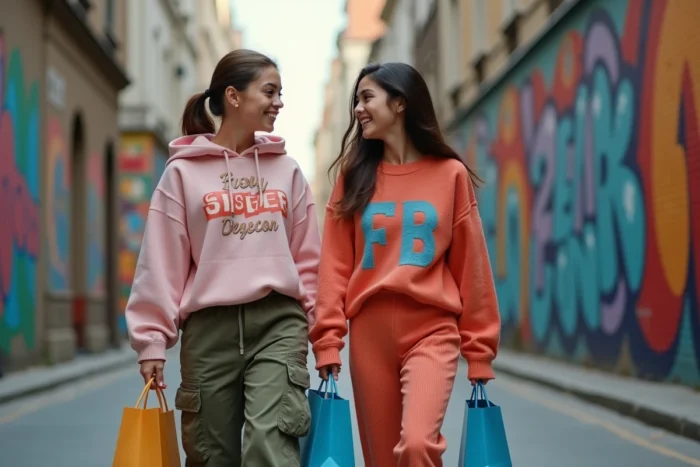
FB Sister does not aim to cover all styles. The brand claims a territory centered on Y2K and streetwear: low-rise pants, cropped tops, cargos, 2000s prints, bright colors. This niche choice allows it to speak directly to the aesthetic codes that have dominated TikTok and Instagram for several years.
This visual coherence has a direct consequence on the brand’s perception. Young fashionistas do not come to FB Sister for a neutral basic. They come for pieces that correspond to a specific aesthetic, already validated by online trends.
A catalog that follows micro-trends without inventing them
FB Sister does not claim to launch new stylistic directions. The brand observes trends emerging on social media and translates them into physical products at low prices, with a relatively short time to market. This responsiveness, inherited from the classic fast fashion model, works because the target audience is not looking for absolute originality. They seek to replicate a look spotted online, quickly and without breaking the bank.
The result: a coherent fashion universe, where each piece fits into a recognizable whole. The clarity of the offer simplifies the purchasing decision, a determining factor for an audience that consumes fashion impulsively and visually.
Low prices and in-store shopping: the combination that appeals to teenagers
The micro-prices of FB Sister are not an accident. They form the foundation of the brand’s proposition. For a clientele often dependent on pocket money or a first student job, the relationship between the displayed price and the immediate satisfaction of an in-store purchase creates a unique dynamic.
- Purchasing is done without a mandatory credit card, unlike online platforms that require a digital payment method, which remains a barrier for some minors.
- In-store fitting eliminates the risk of returns, a major irritant on online fast fashion sites where sizes vary greatly from one product to another.
- Gratification is instant: the customer leaves with their purchase, with no delivery delay or uncertainty about the receipt date.
This physical immediacy remains an asset against e-commerce giants. Field returns vary on the quality of finishes, but the price point set by FB Sister makes the issue less penalizing: at just a few euros per piece, the audience’s tolerance threshold is higher.

Social media and word-of-mouth: low-cost marketing
FB Sister invests little in traditional advertising. Its visibility largely relies on content generated by its customers themselves. On platforms like Vinted, Poshmark, or Instagram, FB Sister pieces circulate in hauls, resales, and daily look posts that function as free recommendations.
This mechanism is not unique to the brand, but it is amplified by two factors. The low price encourages frequent purchases, thus generating regular content from users. The Y2K aesthetic, highly photogenic, lends itself particularly well to the visual format of social networks.
A discreet positioning that avoids controversy
Unlike Shein, which is regularly targeted by awareness campaigns regarding production conditions, FB Sister remains under the media radar. This discretion is partly due to its scale: the brand does not produce the astronomical volumes of ultra-fast fashion from China. It also does not have an aggressive advertising presence that would draw the attention of consumer associations.
The absence of public controversy helps maintain a neutral, even positive, image among a young audience that does not yet associate FB Sister with debates on the environmental impact of fast fashion. The available data does not allow us to conclude whether this relative anonymity results from a deliberate strategy or simply from an insufficient market size to attract the attention of critics.
FB Sister facing online competition: a hybrid model to watch
The FB Sister model relies on a balance between fast fashion codes (price, responsiveness to trends, rapid turnover) and the advantages of physical retail (accessibility, try-on, cash payment). This hybrid position between fast fashion and traditional retail allows it to capture a segment that online pure players do not serve as well: teenagers who want to touch the product before buying it.
The sustainability of this model remains an open question. The youth fashion market evolves quickly, Y2K trends will eventually recede, and regulatory pressure on fast fashion in Europe could change production conditions. For now, FB Sister benefits from a formula that works: a targeted product, a minimal price, a dense physical network, and a generation of customers who promote it without being asked.